Posted On: December 21, 2011

Fatal Claim in PA Compensable Even if Treatment Not Reasonable or Necessary

One aspect of the Pennsylvania Workers’ Compensation system we (thankfully) do not often address is what is known as a “fatal claim,” where the employee is killed in the work accident. This can, of course, occur in the injury itself, or it can occur as a consequence of the original injury.

The Commonwealth Court of PA recently dealt with this latter issue in J.D. Landscaping v. Workers’ Compensation Appeal Board (Heffernan). Here, the employee injured his low back (specifically, he suffered a herniated disc at L4-5, and a lumbar strain and sprain). As a consequence of the work injury, he was taking copious amounts of medications. Unfortunately, the injured worker died as a result of “multiple drug intoxication.”

What makes this case even more interesting, is that, before the death of the injured worker, a Utilization Review (UR) determined that the ongoing use of medications was neither reasonable nor necessary. The last prescription which was filled was prescribed by a different doctor, though a member of the same practice as the doctor subject to the UR (and, remember, a UR only binds the specific doctor against whom it was filed).

The Workers’ Compensation Judge (WCJ) granted the Fatal Claim Petition, finding that the medications which led to the death of the injured worker were prescribed for the work injury, so the death was related to the work injury. As to the effect of the UR, the WCJ found that the doctor who prescribed the last medications was not the same as the doctor against whom the UR was filed, so the UR was not binding on that new doctor (despite being at the same practice). This decision was affirmed by the Workers’ Compensation Appeal Board (WCAB).

The workers’ comp insurance carrier appealed to the Commonwealth Court of PA, arguing the Fatal Claim Petition was granted in error because the medications leading to the death were found unreasonable and unnecessary by UR. The insurance company argued, though a UR is typically provider-specific, in this case it should not be, because the prescriptions were the same as those of the provider under review and the prescriptions were done with the knowledge and approval of the provider under review.

The Court concluded that the question of whether the doctor writing the last prescription was subject to the UR is irrelevant. By law, a UR may address only whether treatment is reasonable or necessary, not whether it is related to a work injury. In this case, the only question of relevance for the Fatal Claim Petition is whether the prescription was related to the work injury. This fact was not disputed. As such, said The Court, the Fatal Claim Petition was properly granted.

Posted On: December 16, 2011

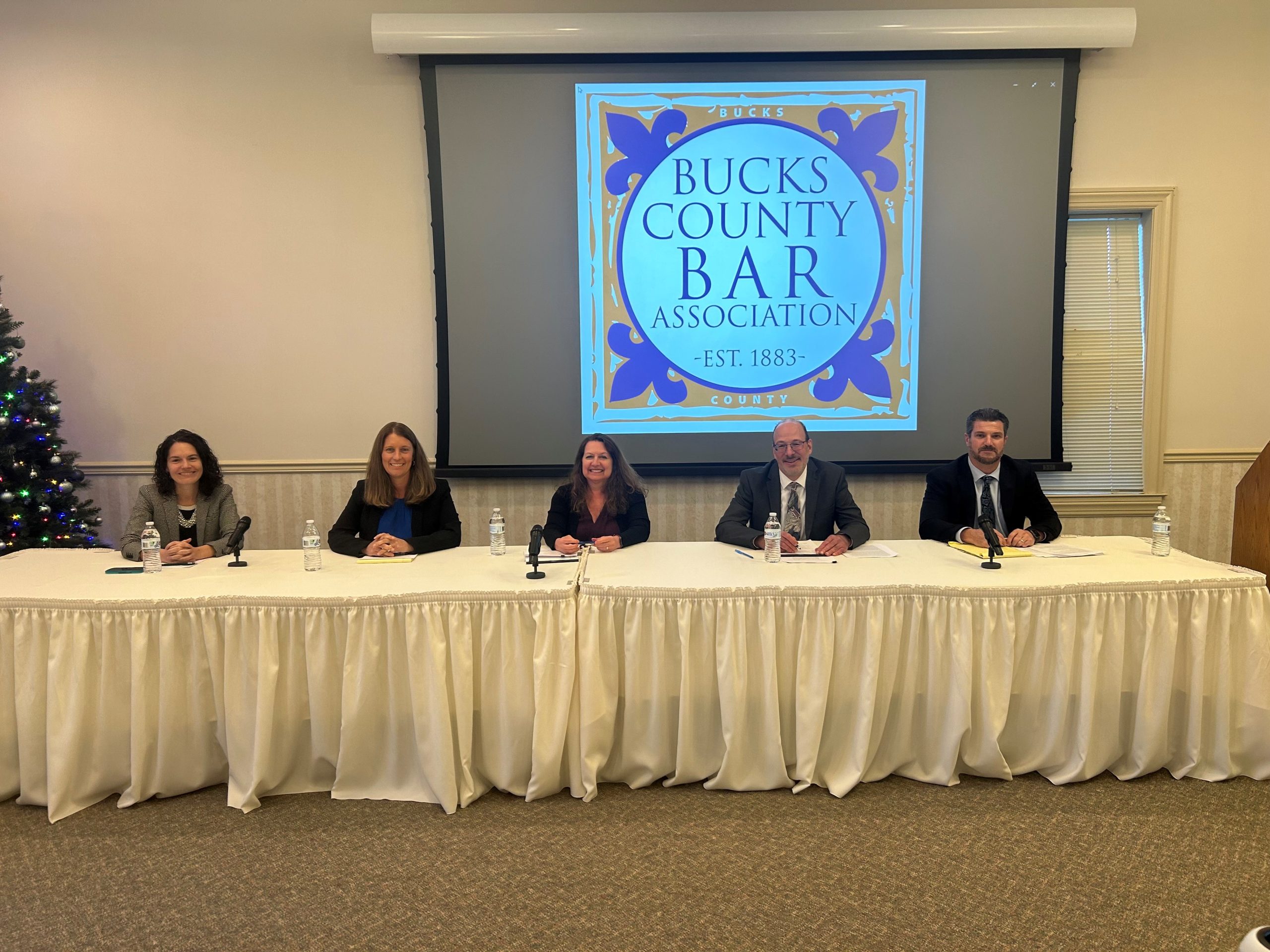
Brilliant & Neiman’s Dina Brilliant Named Co-Chair of Bucks County Bar Association’s Workers’ Compensation Section

We at Brilliant & Neiman LLC are proud to announce that Dina Brilliant, a partner at our firm, has been elected Co-Chair of the Bucks County Bar Association’s Workers’ Compensation Section. Ms. Brilliant will be taking the reins from the previous Co-Chair of the Section, Glenn Neiman, also a partner at Brilliant & Neiman LLC. As is customary for the Section, the other Co-Chair comes from the defense/insurance carrier side. Elected to this position was Diane Ingbritsen, an associate at the defense firm of Hill Wallack LLP. Each of these Co-Chairs will serve a two-year term.

The Workers’ Compensation Section meets throughout the year to discuss developments in the field of PA workers’ compensation, and to provide a connection between the attorneys practicing in the area of workers’ comp and the Workers’ Compensation Judges, who hear such cases. The Section also periodically produces Continuing Legal Education seminars, given to both practitioners in the area of PA workers’ compensation and the entire bar of attorneys in Pennsylvania.

Posted On: December 9, 2011

Surveillance Evidence Alone May Stop PA Workers’ Comp Benefits

We have previously tackled the issue of reinstating benefits under the PA Workers’ Compensation Act. Then, though, we were focusing on how an injured worker can get his or her benefits reinstated. A recent case from the Commonwealth Court of Pennsylvania addresses an even stickier issue – whether the injured worker has a burden to demonstrate continuing disability after the reinstatement. As you have probably learned by now, the answer is not black and white.

In Brian Soja v. Workers’ Compensation Appeal Board (Hillis-Carnes Engineering Associates), the Court affirmed the decision of a Workers’ Compensation Judge (WCJ), which reinstated benefits for a period of time, before ordering such benefits suspended. Here, the injured worker returned to gainful employment after a 2005 work injury, causing his benefits to be suspended. When he had a recurrence of his symptoms, again rendering him disabled, he filed a Petition for Reinstatement, as of November 1, 2006.

In the ensuing litigation before the WCJ, the injured worker testified three different times, the last of which was on April 24, 2008. At that time, he testified that he had trouble standing or walking, and he required the use of a cane. The workers’ compensation insurance carrier subsequently offered a surveillance tape of the injured worker, taken on that very day he testified on April 24, 2008. Here, the injured worker was seen limping and using a cane as he entered the hearing office. Later that day, though, he was seen walking freely, without the need for a cane, bending, twisting and otherwise acting in direct contrast to his presentation to the WCJ.

The WCJ granted the Petition for Reinstatement as of November 1, 2006, since the injured worker proved his symptoms recurred. However, the WCJ then ordered the benefits suspended as of April 24, 2008, based solely on the surveillance tape. The WCJ found the testimony of the injured worker not credible as to his condition after that date.

Claimant filed an appeal with the Workers’ Compensation Appeal Board (WCAB), arguing first that his workers’ compensation benefits could not be suspended solely on the basis of surveillance evidence, and second that once he proved a right to a reinstatement of benefits, the burden for suspension fell to the workers’ comp insurance carrier. The WCAB was unmoved by the injured worker’s arguments and affirmed the decision of the WCJ. Further appeal was then filed with the Commonwealth Court of PA.

There, the Court addressed when surveillance evidence could support a suspension of benefits:

“In sum, where an employer files a petition to reduce a claimant’s benefits from total to partial disability, the employer has the burden of proof. In that situation, a video is inadequate evidence standing alone. Rather, the video must be examined by a physician or vocational specialist who can offer evidence of what kind of jobs the claimant can do, other than his pre-injury job. Likewise, where the employer has filed a termination or suspension petition, a video will not be sufficient to satisfy the employer’s burden of proof.”

When, as here, the injured worker bears the burden of proof, the role of surveillance evidence depends on the basis for the reinstatement. Because the claimant here alleged a reinstatement based on a recurrence of his symptoms, the claimant retained the burden to prove continuing disability. Thus, the WCJ correctly, based on his findings of fact, suspended the benefits based on the surveillance.

The Court distinguished a Petition for Reinstatement based on the injured worker’s loss of a light duty job; in that case, the workers’ comp insurance carrier bears the burden and surveillance evidence alone cannot support a suspension of benefits.

Posted On: December 9, 2011

Brilliant & Neiman Changing Phone Number from (215) 244-8101 to (215) 638-7500

As we get ready to move our Trevose office to another building in the Neshaminy Interplex, we at Brilliant & Neiman LLC are changing our telephone number at this office from (215) 244-8101 to (215) 638-7500. For those unfamiliar with the Trevose area, Neshaminy Interplex is located on Route One/Roosevelt Boulevard at Old Lincoln Highway.

The Neshaminy Interplex is just South on Route One from Morrisville, Yardley, and Langhorne/Oxford Valley, in the Bensalem area. We are just South of the Philadelphia Exit off the Pennsylvania Turnpike, and just South on Route One from the I-95 Interchange. We are just North of Northeast Philadelphia (just after Roosevelt Boulevard becomes Route One). Truly a location convenient to almost all of Philadelphia, Montgomery and Bucks Counties.

Our other telephone numbers will remain the same, (610) 740-1002 for our Allentown office, and (888) WORK HELP for our toll-free line. We also continue to have meeting locations available throughout Southeastern and Central Pennsylvania, for the convenience of all of our clients.

Posted On: December 2, 2011

PA Workers’ Comp Claim Denied for Violation of Positive Work Order

Generally speaking, the PA workers’ compensation system is a “no fault” system. It usually doesn’t matter why an employee gets hurt, as long as he or she was doing his or her job at the time. As with most rules, of course, there are exceptions. One exception to this rule is when a work injury is suffered through the violation of a positive work order.

One common thread in cases which discuss the “violation of a positive work order” defense is an incredibly stupid action on the part of an injured worker. A recent decision by the Commonwealth Court of Pennsylvania, in Habib v. Workers’ Compensation Appeal Board (John Roth Paving Pavemasters), did not deviate far from this thread.

In this case, the employee, a laborer, was awaiting a delivery of asphalt. To pass the time, he elected to see if he could break a bowling ball with a sledgehammer. The employee struck the bowling ball once, and it cracked. The foreman then told him to “knock it off.” Undaunted, the employee smashed the ball again, causing a piece of the ball to strike the employee in the eye (leading to a loss of his eye).

The injured worker filed a Claim Petition, seeking compensation for the loss of his eye, and the case was litigated before a Workers’ Compensation Judge (WCJ). The WCJ granted the Claim Petition, finding that there was no violation of a positive work order. The WCJ found the injured worker was merely careless, and that the words from the foreman did not come sufficiently in advance to rise to the level of a positive work order.

The Workers’ Compensation Appeal Board (WCAB) reversed this decision on appeal, finding that the communication from the foreman was sufficient under the Pennsylvania Workers’ Compensation Act to become a positive work order. The decision of the WCAB was affirmed by the Commonwealth Court of Pennsylvania.

While the WCJ is indeed the ultimate finder of fact, appellate courts are able to use those findings as they see fit. The question of whether an injury was suffered in the scope and course of employment is a question of law, fully reviewable on appeal.

The Court noted that there are three elements to finding a violation of a positive work order, and all three are present in this case. First, the injury must be caused by the violation of the work order (striking the ball caused the shard to go into the injured worker’s eye). Second, the employee must know about the work order (the injured worker was specifically told to “knock it off”). Lastly, the order must relate to an activity not connected with the employee’s work duties (here the injured worker’s job was not to strike a bowling ball with a sledge hammer). Since the workers’ comp insurance carrier prevailed on all three elements of this defense, the injured worker is precluded from receiving benefits for the injury.